Showing posts with label home buying. Show all posts

Thursday, May 16, 2013

Critical structural elements for a manufactured home installation

Note that the constructions in this document conform to the Ohio Manufactured Home Commission’s rules (ORC 4781). Since these rules were developed from the HUD model guidance documents (24CFR-3285), the installations should meet other states’ manufactured home installation rules developed from the 24CFR-3285; but you should verify that fact. These constructions should also meet FHA guidelines since precursor documents to 24CFR-3285 were used to develop HUD 7487-Permanent Foundations Guide for Manufactured Housing, although some engineers may still require fully mortared piers, using strict interpretation of HUD-7487.

Directions for Typical Carriage and Marriage Wall Pier Construction

Photo 1

NOTE: Cap Blocks need to be 8” X 16” ASTM C145 concrete or 2” minimum thickness hardwood blocks on ALL piers. Other materials may be permitted EXCEPT 2” thick concrete blocks, which are NOT allowed as cap blocks or plates because they crack easily. An inspector may allow 2” blocks to be used lower in the pier stack; but be sure to check first with your inspector. Fully mortared piers should not require cap blocks.

ALSO NOTE: ALL piers are installed at a right angle to the carriage beams and marriage wall and need to be centered under the carriage beams or marriage wall. Pier blocks need to be within ½” of plumb. Piers at the ends of each carriage beam need to be within 24 inches of the end of the beams.

Rechecking the level of the home and tightness of the piers after shimming all piers the first time is highly recommended. Leveling the home in one area may throw off the level in another. The level of newly set homes and tightness of its piers should also be checked after about six months and a year because the slab or footings could have settled. A recheck should also be done if the home develops cracks in the drywall, doors or windows that do not open or close as before, or gaps in places where they were not present before.

Directions for Double Stack Carriage Beam Piers And Tie-Down Straps

Photo 2
Photo 3
Photo 4

*Some locations permit use of ABS pads. I do not support use of them without proper soil testing or strict installation according to the
manufacturer’s instructions, both of which are rarely done. So, in general, I don’t support their use. This is my document; so it follows my rules.

Directions for lateral brace installation

Photo 7   Photo 5 Photo 6

NOTES:

These photos show only one manufacturer’s lateral brace. Other manufacturers have slight variations.
Be sure to read and follow the manufacturer’s instructions for the particular brace being used.
The brace should not be bent or cut unless listed in the instructions.
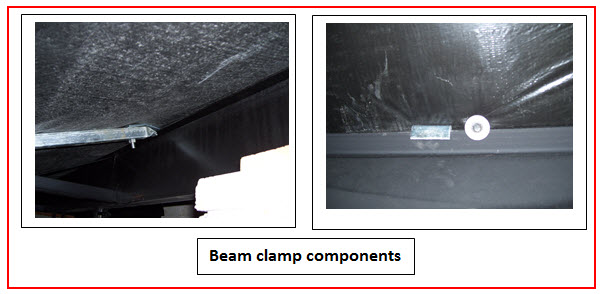
No other beam clamp should be used or even manufactured for use with a particular manufacturer’s brace.
Yes, I have seen all of these cases.
Most lateral brace manufacturers require tie down straps at the corners of single-wide homes.
At least two braces are required for each home—located near opposite corners of the home and installed in opposing directions.
Homes over 76’ box length may need more braces.
Be sure to check the brace manufacturer’s installation instructions.

A PDF version of this document may be obtained by contacting:
Criterium-Cincinnati Engineers
criterium-cincinnati@fuse.net
513-474-9600

Sunday, March 7, 2010

A potential Freon fiasco

One of the inspector message boards recently posted a letter from one of the home warranty companies to realtors about Freon.  The parts of the letter related to most homeowners are duplicated below:

Starting January 1, 2010, a new Environmental Protection Agency (EPA) mandate will change the way your clients' home

air conditioners are serviced and repaired. At that time, manufacturing HVAC equipment that primarily utilizes Freon®

(also known as R-22 and HCFC-22) will be banned, and the nation will begin using products such as Puron® (also known

as R-410A) as the standard refrigerant for air conditioners. This change will affect your buyers and sellers in many ways.

Costs will increase


A variety of factors will lead to increased costs:


  • R-22 parts may no longer be available.

  • Since R-410A parts are not always interchangeable with R-22 parts, replacement of the entire system might be necessary.

  • Physical changes to your system may be needed to accommodate the larger equipment required in air conditioners using R-410A refrigerant.

  • The supply of R-22 refrigerant will be limited, causing the price to increase.

  • Repairs may take longer because you may want to explore your options and wait for less expensive parts, if they are available.

  • New HVAC equipment may be more expensive to purchase and install.


Manufacturers' warranties may not provide full coverage


Typical manufacturers' warranties only cover parts for one year, in most cases. Labor is a significant part of any repair.

Each manufacturer may take a different position if an R-22 system cannot be repaired or parts are not available.

System and appliance warranties/ service contracts typically exclude coverage resulting from government mandated changes

Most system and appliance home service contracts/warranties contain language that effectively excludes the additional

costs resulting from this government-mandated change. Each home service contract may deal with this situation

differently.

Visit www.r410asolutions.com to answer all your questions concerning the impact of this new government mandate to you and your clients or call 877-777-3188 to deliver real time answers to agents and homeowners.
Even though the letter was originally written to realtors, it contains information that is important to homeowners, particularly the parts about prices of the Freon alternative.  But, one other part of the letter, which I did not include here, was that homeowners who are selling will likely now have to disclose any Freon systems.  As home buyers get wise to the Freon system problems, sellers will likely end up reducing their selling price because of the Freon problems.  Likewise, if you are in the market for a home, you may want to ask about whether the air conditioning system uses Freon.  Most likely it does or it will (depending on which side of the sell you are on).  That means in turn that older air conditioning systems that need repair might end up being cheaper to replace than repair.